
Somewhere in India today, a tender is being won.
Not published. Not submitted. Won.
No portal shows it. The NIT does not exist yet. But inside an implementing agency, a requirement is slowly taking shape, and one firm is already in the conversation. Asking questions. Presenting capability. Choosing a partner. Moving its best project director. Arranging finance. When the tender finally publishes, that firm will “respond” to it the way an actor responds to a script he has spent a year rehearsing.
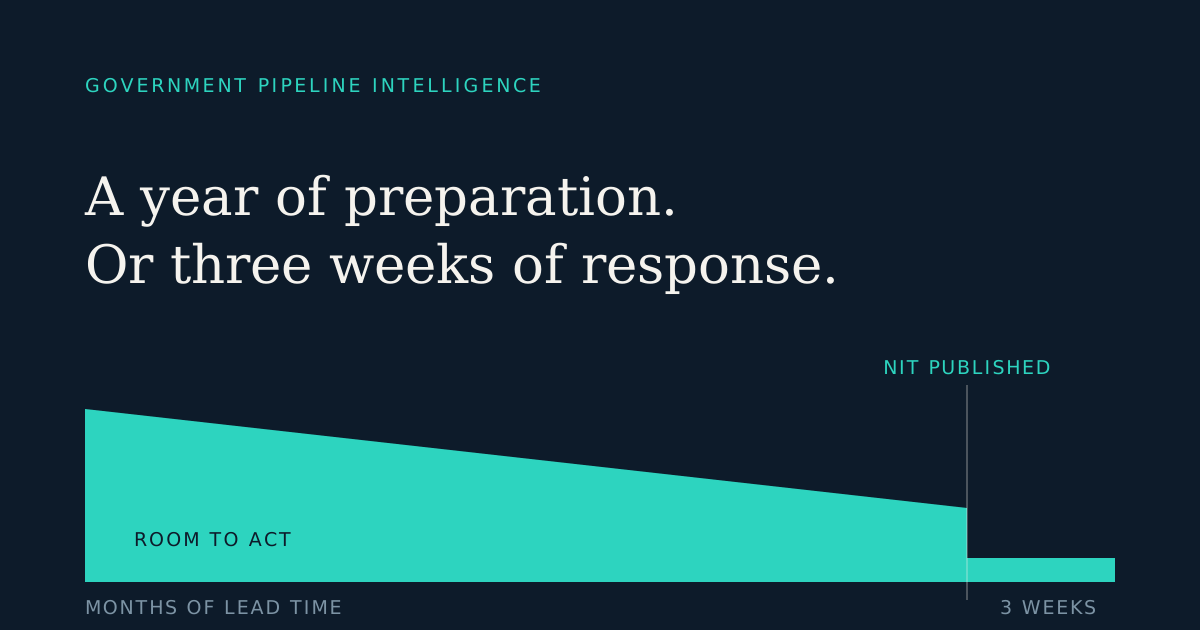
Everyone else will get three weeks inside the bid window after the tender is published.
We are taught to treat the tender as the starting gun. It is closer to the finish line. The race began months earlier, in budget allocations, entrustment notifications, clearances, board approvals and consultations, and most of the field never knew it was on.
This is not a theory. On 16 January 2026, a new national highway was formally entrusted to the agency that would build it: NH-317A in West Bengal. The tender for that same highway was published on 18 May 2026. For four months the project sat in the public record, visible to anyone reading entrustment notifications, invisible to everyone watching tender portals. We told that story when we defined Government Pipeline Intelligence as a category.
This post answers the next question, and it is the question that matters more: what would you actually do with four months? Or fourteen?
Because here is the truth the Indian market has never had to confront, having never had systematic early knowledge to begin with.
Lead time, by itself, is worth nothing. A signal you see early and act on late is just a longer wait. The value lives entirely in the activities that lead time unlocks.
And there is a hard test for what belongs on that list. A real lead-time activity must pass two gates: it must be impossible to do well after the NIT is out, and it must change the outcome, meaning who wins, or at what margin. Ten activities pass both gates. Two of them tower over the rest.
Start with those two.
1. Be in the room while the requirement is still a question
Every tender is preceded by a long stretch in which the buyer does not yet know exactly what it wants. Scope is unsettled. Packaging is undecided. Technology choices are open. During that stretch, the implementing agency is actively trying to learn: field visits happen, consultations happen, expressions of interest and requests for information go out, industry interactions get scheduled.
The unit has a different name in every industry. On a highway it is the project implementation unit. In an e-governance programme it is the nodal agency. Inside a power or petroleum public sector undertaking it is the project cell. The behaviour is identical everywhere: before the buyer writes, the buyer asks.
A firm that arrives during the asking gets to discuss the problem. A firm that arrives after the tender gets to discuss the price.
And there is a quieter effect. Evaluation committees are made of people, operating within rules. When your firm has spent a year being a serious, useful, visible participant around a project, your bid is read as the bid of a known quantity. When your first appearance is the bid itself, you are a stranger’s PDF. Nothing about this is a back channel. It is the front door, entered early.
2. Help shape the requirement, in the open
Now the part that serious players understand and almost nobody writes down.
Requirements are not born whole. Somebody drafts them, and drafting teams look for input. That is exactly what the official machinery of pre-tender consultation is for: requests for information that ask industry what is possible, draft specifications published for comment, pre-bid conferences that exist to refine the document, technical presentations that agencies invite precisely because they do not want to specify blind.
A firm that participates in that machinery, honestly and through the official channels, ends up in a specific position: the final requirement reflects an understanding of the problem that the firm helped build. When the specification asks for something you genuinely do well, that is not luck. It is the compounding return on showing up early with real substance.
Be clear about what this is and is not. The buyer runs the process. Everything happens in the open, on the record, through channels the government itself created because it wants better-informed procurement. The advantage is earned by contributing understanding, not by pulling strings. That is why the firms best at this are usually the ones with the deepest engineering, not the deepest connections.
And the uncomfortable converse: the requirement will be shaped by somebody. If you are absent for the year in which it forms, you will bid on a document quietly moulded by whoever was present. Often that is the incumbent. Reactive bidding does not just cost you time. It hands your competitor the pen.
These two activities are where the largest value sits. But they do not pay off on their own. They pay off because of eight more activities running behind them, and those eight are where lead time turns from advantage into arithmetic.
Build the team that wins
3. Structure the JV or consortium deliberately. Large government work is won by combinations: an IT integrator with an equipment manufacturer, a civil contractor with a systems house, an engineering firm with a process-technology licensor. After the tender is out, you partner with whoever answers the phone in week one, and they negotiate knowing you are desperate. With a year, you map the capability gap, court the right partner, negotiate terms as an equal, and structure the entity so it clears the eligibility criteria by design rather than by hope.
4. Line up the key personnel the scoring sheet will reward. Technical evaluation scores named CVs: a project director with the right years and the right past projects, certified specialists, key personnel who must be committed to this bid. You cannot invent a qualified project director in three weeks. You can absolutely hire, reassign, or certify one in a year, and the firms that do treat their bench as a pipeline asset, staged against what is coming.
5. Close the eligibility gaps before they are fatal. Most losses do not happen at evaluation. They happen at eligibility: a turnover threshold missed, a similar-work credential absent, an empanelment or certification never obtained. Discovered at the tender, each of these is a dead end. Discovered a year out, each is a project plan: a qualifying job taken deliberately, a certification pursued, a credential built through a smaller contract first.
Get capital and capacity ready
6. Arrange money and machines at the pace money and machines actually move. Equipment financing, bank guarantee limits, bid security, working capital lines, and the long-lead physical items that gate execution: none of these move in weeks. Financiers price desperation. A firm that starts arranging capital when the signal appears, rather than when the tender does, borrows calmer and cheaper, and walks into the bid with capacity already secured instead of promised.
7. Set up for local-content preference while there is still time to localise. Across defence, rail, energy, telecom and electronics procurement, Make in India preference rules can decide who is even competitive. You cannot localise a supply chain in three weeks. In a year, you can qualify domestic suppliers, restructure sourcing, or stand up local assembly, and arrive as a preferred class of bidder instead of pleading for exemptions.
Engineer the bid itself
8. Differentiate on the actual problem, not the document. Firms that start at the tender all read the same pages and produce the same generic response. Lead time lets you study the real thing: walk the site, understand the geology or the legacy systems or the crude slate, and design a method statement or solution architecture around what is actually there. When your bid contains understanding no one else bothered to earn, evaluators notice, because it is rare.
9. Price with judgement instead of adrenaline. The budget envelope for most public projects is visible in public documents long before the tender. A year of visibility means a cost model built carefully, supplier quotes gathered without a countdown, and a price that is a decision rather than a guess. On thin government margins, the difference between a considered price and a panicked one is, over a portfolio, the difference between a profitable public-sector practice and an expensive hobby.
10. Choose your fights like a portfolio manager. Proposal effort is real money, and it is your scarcest resource after credibility. A pipeline visible only three weeks ahead forces you to bid whatever appears. A pipeline visible quarters ahead lets you pursue fewer opportunities with full weight, decline early the ones you cannot win, and put your best people where the return justifies them. Win rate is not a talent. It is an allocation decision, made possible by time.
The market that never built this muscle
Read the ten again and notice something: none of them is exotic. The best firms in every industry already do fragments of this, wherever an accident of relationships gave them early sight of one project. What no firm in India has ever had is the ability to do this systematically, across every account that matters, because systematic early knowledge did not exist here. The tender aggregators begin where the race ends.
That is the muscle this market never got to build, and it is exactly why we believe Government Pipeline Intelligence had to be defined as a category. Dusams exists to supply the input: the signal, months or years early, with the evidence one click away. The ten activities above are what you do with it. On contracts measured in tens and hundreds of crores, that is not a research advantage. It is a line in the P&L.
Somewhere in India today, a tender is being won, and it will not be published for months.
The only question is whether your firm is in that race, or waiting politely at the finish line for the three-week sprint to begin.