
Somewhere in your inbox this morning there is a tender you are going to lose.
Not because your price will be wrong. Not because your technical bid will be weak, or your documentation incomplete, or your past performance thin. You will lose because that tender is the end of a conversation that has been going on for a long time, and you were never in it. By the time it reached you, the specification had already been shaped by someone who was.
You have three weeks. Someone else has had a year.
That is not a story about corruption. It is a story about reading speed.
Work backwards from any contract
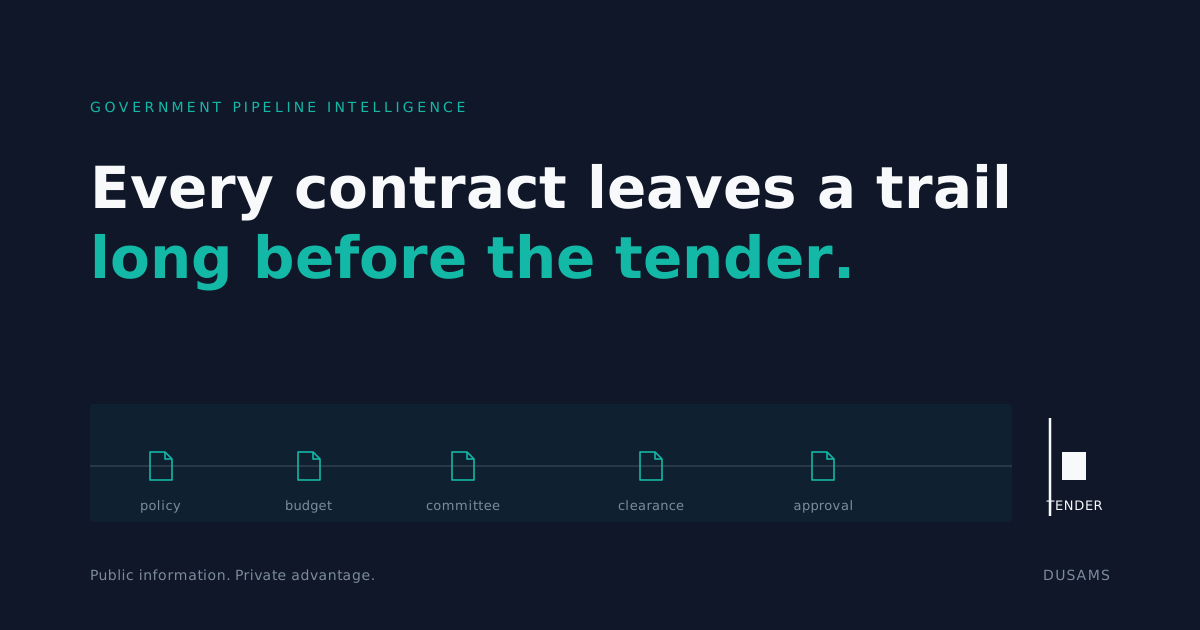
Take any large central government or PSU contract awarded in the last two years and walk backwards from the award.
Before the award, there was a tender.
Before the tender, there was an administrative approval: a sanction, a board resolution, a note recording that the department intended to spend this money on this thing.
Before the approval, there was a budget. A line in the Detailed Demands for Grants, the document each ministry publishes every year setting out what it plans to spend and on what.
Before the budget, there was scrutiny. A Parliamentary Standing Committee sat with that ministry, questioned the allocation, and published a report saying what was funded, what was delayed, and what the ministry asked for and did not get.
Before the committee, there were answers. A Member of Parliament asked a question about a corridor, a plant, a modernisation programme, and the ministry replied on the record with project names, stages and numbers.
And for anything that touches land, there was a clearance. Before a single brick moves, the project file sits on a public environmental clearance portal, setting out location, scope, capacity, cost estimate, promoter and current stage in more detail than the eventual tender will ever contain.
Now the part that should be uncomfortable.
None of that was leaked. None of it was obtained through a contact. Every document in that chain was published, in English, on a government website, with a date on it, available to you and to your competitor at the same moment.
The information was never the problem. The reading was.
One road, four months
On 16 January 2026, the government formally entrusted a new national highway to NHIDCL, the agency that would build it. The road is NH-317A, running from near Hasimara to the India/Bhutan border in West Bengal. That entrustment was a public notification the day it was signed.
The tender for that same highway was published on 18 May 2026.
Four months. A vendor who read the January notification had four months to understand the project, reach the agency, and prepare, before the bid clock everyone else waits for had even started. And this was the second attempt to tender the work, so anyone tracking the entrustment had seen it coming for longer still.
One road. One document, published in the open, correctly read. Four months of head start.
The Old Way, and why it deserves respect
For the last fifteen years, the answer to this problem in India has been tender aggregation.
It deserves more credit than it usually gets. Central portals, state portals, PSU portals, department portals: thousands of them, no common format, no common vocabulary, no reliable notification. Finding out what had been published at all was a genuinely hard problem, and the aggregators solved it. They still solve it. Every serious firm selling to government uses one, and should.
But look closely at what the entire category is built to do.
It monitors publication. It watches the moment a tender becomes public and it tells you quickly. Everything built on top of that foundation makes you faster and sharper inside the window that begins at publication: better search, better filters, better alerts, eligibility checks, AI that reads the tender and drafts your response.
That is the ceiling. Not a flaw in any one product. The ceiling of the approach.
Because by the moment of publication, the specification is written. The budget is committed. The department has already met vendors, seen demonstrations, taken inputs on what is technically feasible, and formed a view about who can deliver. The tender is the record of a decision, not the start of one.
So the entire market has spent fifteen years getting better and better at the last three weeks.
Adding AI to a published tender makes you faster inside the window. It does not move the window.
Moving the window requires a different question. Not what has been published? but what is being decided?
The New Way: Government Pipeline Intelligence
Here is the definition.
Government Pipeline Intelligence is the practice of tracking a government buying decision from the point at which it first becomes visible in the public record, rather than from the point at which it becomes a tender.
Three words, each doing work.
Government. A buyer unlike any other, because it is legally obliged to think out loud. A private company can decide to spend two hundred crore rupees and tell nobody until it issues a purchase order. A ministry cannot. It must budget in public, answer questions in public, be scrutinised in public, and obtain clearances in public. Its decisions are slow, procedural, and documented at every stage. That is not a weakness in the buyer. It is an opening for the seller who is paying attention.
Pipeline. Not an event. A sequence. A single buying decision moves through stages over months or years, and each stage leaves a different kind of record in a different place. A policy document does not mean the same thing as a board approval. Both matter. They sit at different distances from the tender, and treating them as equally urgent is as useless as treating them as equally distant.
Intelligence. Not a feed. Not an alert. Not a keyword hit. A signal that has been read, dated, attached to the government body it belongs to, matched against what your company actually sells, and delivered with the source document one click away. A business development lead can act on it in the next hour instead of investigating it for the next week.
The difference between the two approaches, stated plainly:
| Tender aggregation | Government Pipeline Intelligence | |
|---|---|---|
| Starts at | Tender publication | First public trace of the decision |
| Answers | What has been published? | What is being decided? |
| Source material | Tender portals | Budgets, committee reports, parliamentary answers, clearances, approvals, PSU disclosures |
| You get | Days | Months |
| You can | Respond | Engage, shape, qualify out |
| Your position | One of many respondents | Known to the department before the specification is written |
The second is not a better version of the first. It is a different job.
Why now, and not five years ago
This is the question that matters most, because if this were possible in 2016 somebody would have built it in 2016.
Three things had to become true at the same time.
The record went digital. Environmental clearances, committee reports, parliamentary answers, budget documents, PSU disclosures: this material has always been public in principle. For most of its history it was public the way a library is public: real, findable, and effectively out of reach for a working sales team. Over the last several years it has moved onto structured portals with search, dates and permanent links. Public stopped meaning theoretical.
The volume became unreadable. And immediately created a new problem. Being available is not the same as being readable. A single committee report runs to hundreds of pages. Dozens of ministries, scores of public sector undertakings, several clearance and disclosure systems, all publishing continuously. One diligent analyst can watch three websites well. No team can watch ninety. So most of it goes unread, not for lack of effort, but because a person reads at the speed of a person, and the record grew faster than anyone could keep up with.
Machines learned to read. Not to search. To read. Software that can take a two hundred page report in dense government English and answer whether it contains a procurement intention relevant to a firm that builds highways, at a cost per document low enough to run across an entire ministry every night, is genuinely recent. That capability is a few years old at usable quality. Before it, this product could not have existed at any price.
Public record, unreadable volume, machines that read. The first two have been true for a while. The third arrived recently. The overlap is the opportunity, and the overlap is now.
There is a fourth reason, and it is about you rather than us. Plenty of firms already do a version of this by hand: a good analyst who reads the budget documents, a sales head who tracks two ministries closely, a founder with long memory and better contacts than most. It works, and it does not scale. What no one in your market has yet is a system: every relevant source, every night, matched to what your firm actually sells. That is the difference between an advantage that depends on one person staying, and one that belongs to the company.
What actually changes
Firms that operate this way stop doing three expensive things.
They stop finding out last. Contact happens while the requirement is still being formed, not after it has been frozen into a specification written around somebody else’s capability.
They stop bidding blind. A pursuit can be judged on its history: how the budget moved, what the committee said, which stage the clearance reached. Not on the tender document alone.
They stop paying to lose. Every bid a firm should never have entered carries a real cost in proposal team hours, partner time and management attention. Knowing early is also knowing early enough to walk away.
Why this has to be built for India
The idea itself is not untested. Government vendors in other markets have been buying pre-tender intelligence for years, and it works. What has never existed is a version built for how the Indian government actually publishes: the ministries, the public sector undertakings, the committees, the clearances, the budget cycle, and the specific documents that matter here and nowhere else.
That is the work. It is a data problem before it is a software problem, which is why it takes real effort and why it holds once it is built.
We are calling this category Government Pipeline Intelligence, and we are building it for the Indian market at Dusams.
Public information. Private advantage.
The trail is already there. It always has been. The only question is who reads it first.