Dusams

Government Pipeline Intelligence

You're not losing bids. You're finding out too late.

At Dusams we track every upstream signal the Indian government produces and surface the projects that matter to you, months before the tender drops
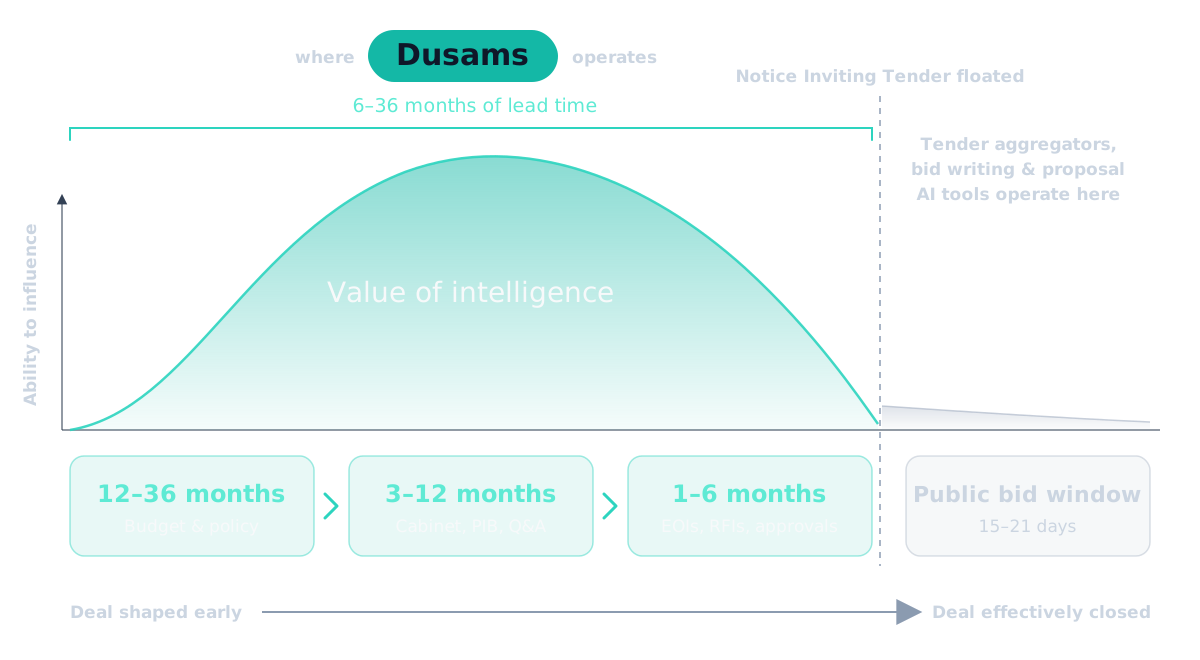
Chart plotting the ability to influence a government deal against time. A teal value-of-intelligence curve peaks in the upstream window where Dusams operates, 6 to 36 months of lead time before the Notice Inviting Tender is floated, spanning budget and policy signals, cabinet and PIB announcements, and EOIs and approvals. After the tender publishes, the curve collapses into the 15 to 21 day public bid window where tender aggregators and bid-writing AI tools operate and the deal is effectively already closed.

The problem

The Invisible Trail

You're not losing bids. The tender is just where you find out.

Every government tender has a 4-24 month head start. Budgets get approved, feasibility studies commissioned, specs shaped by incumbents, and decision-makers briefed. By the time it lands on CPPP with a 15-21 day window, the outcome is already written. You're responding to decisions made months ago, in rooms you couldn't see.

The paper trail is public. It's fragmented across ministry reports, PIB releases, NITI Aayog studies, parliamentary Q&A, PSU disclosures, and regulatory filings. But it's public.

WHAT YOU SEE THE TENDER 15–21 DAY WINDOW WHAT YOU DON'T −6 MONTHS OUT Specs set by incumbents −12 MONTHS OUT Budgets & approvals cleared −24 MONTHS OUT Policy & capital direction

Public information. Private advantage.

Verified upstream signals

Where every tender begins

Every tender below started as a public signal months earlier. A budget line, a clearance filing, a cabinet approval, a board resolution. By the time these projects reached CPPP, they had already been visible in the government's paper trail for 9 to 22 months.

This is what the upstream trail looks like when you read it systematically.

90+ government sources tracked9-22 months typical lead time before tender

Maharashtra · Highways & Infrastructure

Six-laning of a state expressway corridor

₹1,240 crore

Signal caught:
February 2025 (environmental clearance filing)
Tender published:
June 2026

16 months earlier

Uttar Pradesh · Railways

Overhead electrification of a trunk rail section

₹680 crore

Signal caught:
November 2024 (cabinet approval)
Tender published:
September 2026

22 months earlier

Rajasthan · Energy

Utility-scale solar park development

₹2,150 crore

Signal caught:
August 2025 (PSU board approval, investor filing)
Tender published:
May 2026

9 months earlier

Karnataka · Water & Urban Infrastructure

Rural water supply augmentation, phase 2

₹420 crore

Signal caught:
March 2025 (state budget allocation)
Tender published:
July 2026

16 months earlier

Odisha · Ports & Logistics

Deep-water berth and cargo terminal expansion

₹1,850 crore

Signal caught:
January 2025 (ADB procurement plan)
Tender published:
February 2026

13 months earlier

The upstream advantage

Why upstream beats downstream

Tender aggregators list a project once it is public. Bid tools help you respond to it. Both operate in the same narrow window at the very end, when the requirement is already written. Dusams works the months before, while the budget, the feasibility study, and the specification are still being decided.

Budget
Feasibility
Specs
Tender published
Award
Dusams
Aggregators
Bid tools
Aggregators tell you a tender exists. Bid tools help you respond to it. Dusams tells you it's coming, while you still have time to shape it.